 Skip to content
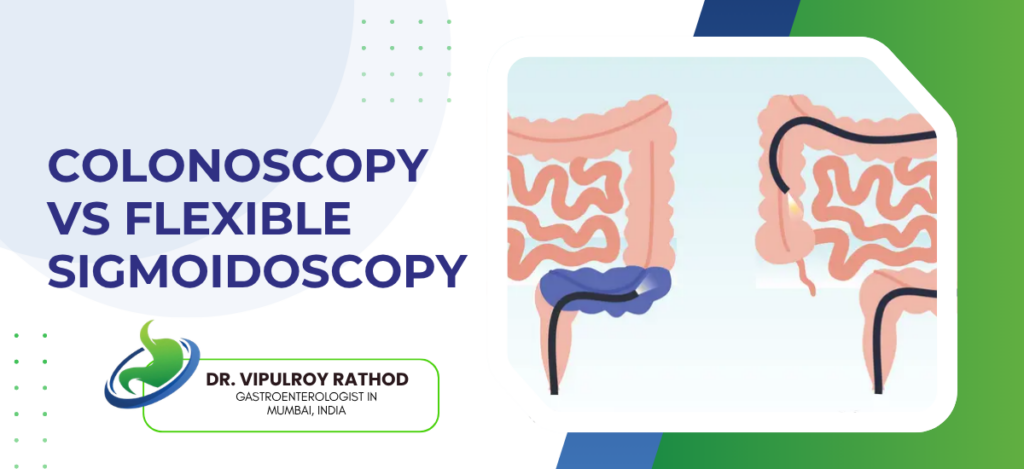
Colonoscopy provides a complete examination of the entire large intestine (colon and rectum), making it the gold standard for cancer screening. Flexible sigmoidoscopy examines only the lower third (sigmoid colon and rectum). Colonoscopy requires extensive prep and sedation, while sigmoidoscopy needs less prep and no sedation.
According to Dr. Vipulroy Rathod, an experienced Gastroenterologist in Mumbai, “Both procedures have their place but they’re not interchangeable, and choosing the wrong one for the clinical question being asked is one of the more common reasons patients end up needing a second scope to get the right answer.”
What is the difference between colonoscopy and flexible sigmoidoscopy?
On paper they sound similar. Both use a thin scope with a camera at the tip. Both go in through the rectum. Where they actually part company is the reach inside the body, and that gap matters way more than most patients expect going in.
- Area examined: Colonoscopy goes the whole way through. Rectum, sigmoid, descending colon, transverse, ascending, right up to where the small bowel meets the large. Sigmoidoscopy stops around the 60 cm mark. The whole upper part of the colon stays out of view.
- Bowel preparation: Full colonoscopy prep is the part patients dread most, no question. Day-long liquid diet plus a strong laxative to clear everything out. Sigmoidoscopy is way lighter. Couple of enemas about an hour or two before. Easier on you yes. But the trade-off shows up in what the doctor can see.
- Sedation requirements: Colonoscopy is done under sedation as standard since the scope spends longer in there and reaches further. Sigmoidoscopy doesn’t normally need sedation. Shorter distance, shorter procedure, most patients tolerate it awake without much fuss.
- Time and recovery: Plan on 30 to 60 minutes for colonoscopy plus another hour or two for sedation to wear off afterwards. Sigmoidoscopy is in and out in under 20 minutes. No grogginess. Most patients just drive themselves home.
If your doctor has suggested either of these, our colonoscopy page covers the full picture of what colonoscopy involves and why it stays the more thorough of the two.
When should you choose colonoscopy over flexible sigmoidoscopy?
This isn’t really a patient choice. The decision gets driven by what the doctor needs to see and rule out, and almost every situation points clearly to one or the other.
- Screening for colorectal cancer: Polyps and tumors don’t only grow in the lower colon. They turn up anywhere along the entire length. Sigmoidoscopy misses everything past 60 cm. Which is why no proper screening guideline anywhere recommends sigmoidoscopy alone for colorectal cancer screening in average-risk adults.
- Investigating unexplained symptoms: Bleeding from somewhere unknown. Anemia with no obvious cause. Bowel habits that have shifted and stayed shifted. All of these need the full colon examined. Sigmoidoscopy only helps if symptoms specifically point downstairs to the rectum or sigmoid.
- Family history of colon cancer: Anyone with a parent or sibling diagnosed with colorectal cancer needs colonoscopy. The genetic risk doesn’t sit politely in the lower colon. Sending these patients for sigmoidoscopy alone misses the whole point of why they need earlier screening in the first place.
- Removing polyps during the same procedure: Both scopes can biopsy. But pulling out larger or trickier polyps cleanly needs the working room and sedation that come with colonoscopy. Sigmoidoscopy is mostly for looking. Colonoscopy looks and treats in the same sitting.
For anyone trying to understand why this kind of screening matters at certain ages, our guide on colon cancer screening eligibility in India explains the clinical reasoning and key risk factors.
Why choose Dr. Vipulroy Rathod for colonoscopy or flexible sigmoidoscopy?
Dr. Vipulroy Rathod brings over three decades of advanced endoscopy practice and more than 80,000 procedures done. Colonoscopies and sigmoidoscopies number in the thousands across that work. Depth like that makes a real difference when picking the right scope for the right patient and actually doing it well.
Every consultation here ends with a clear answer on which procedure makes sense and why. No vague recommendations. No defaulting to the easier scope when the harder one is what’s actually needed. Once it’s done, findings get explained properly instead of buried in jargon on a discharge slip.
Book your consultation today with one of India’s most experienced specialists for colonoscopy and sigmoidoscopy procedures.
Frequently Asked Questions
Colonoscopy is more comprehensive because it examines the entire colon, while flexible sigmoidoscopy only reaches the lower portion and is reserved for specific situations.
It’s usually well tolerated without sedation since the scope only reaches the lower colon, though some patients may feel mild cramping during the procedure.
It can detect cancer only in the rectum and sigmoid colon, but cancer further up the colon would be missed without a full colonoscopy.
Yes, but the prep is much lighter than colonoscopy and usually involves one or two enemas a few hours before the procedure.
Reference links-
- Colonoscopy and Sigmoidoscopy Guidelines — American College of Gastroenterology
- Colorectal Cancer Screening Procedures — American Society for Gastrointestinal Endoscopy
