
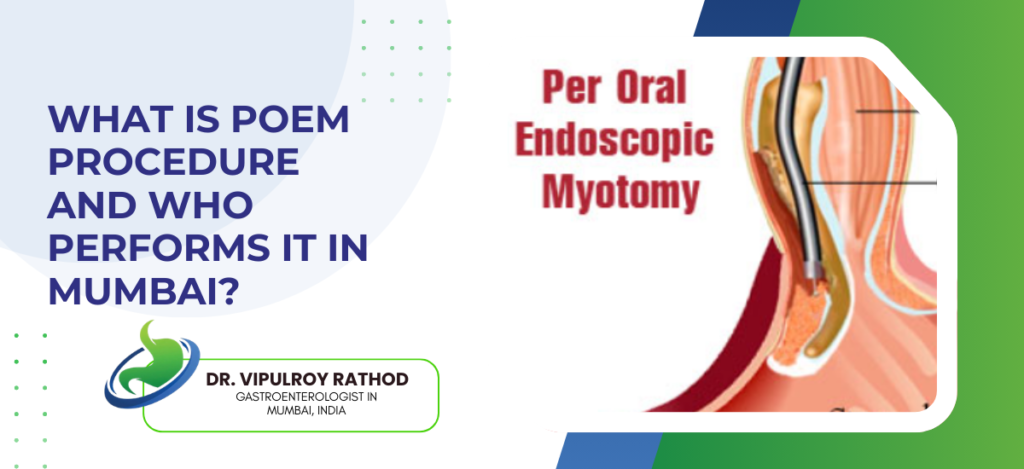
POEM Peroral Endoscopic Myotomy is used to treat achalasia and certain spastic esophageal conditions. No incisions on the body. No surgical entry points. The entire procedure goes through the mouth with a flexible endoscope.
According to Dr. VipulRoy,
“POEM works by cutting the muscle that’s preventing food from reaching the stomach. There’s no wound to recover from. Patients who are good candidates see real, lasting improvement.” For patients with achalasia or swallowing problems that haven’t responded to other treatments, Advanced Endoscopic Procedures for Complex GI Conditions explains how these cases are handled without surgery.
What Actually Happens During a POEM Procedure?
People hear “through the mouth” and think it’s straightforward. It’s not. POEM is a third-space endoscopic procedure. The work happens inside the wall of the esophagus, not just on its surface.
- A small cut is made in the inner esophageal lining — The endoscope goes in through the mouth. That cut opens access to a space between the layers of the esophageal wall. Nothing on the outside of the body is involved at any point.
- A tunnel is created down toward the stomach — Through that internal space, the doctor works toward the lower esophageal sphincter. That’s the muscle that refuses to relax in achalasia. It’s what’s been stopping food from getting through.
- The muscle gets cut under direct view — The myotomy happens here. Muscle fibers are divided carefully, with the endoscope showing exactly what’s being cut. For a deeper understanding of this level of endoscopic work, visit Third Space Endoscopy in Mumbai to see how these procedures are approached as a gastroenterology specialist in Mumbai.
- The entry point is clipped shut — After the myotomy, the tunnel opening is closed with endoscopic clips. No stitches. No external wound. Most patients leave the hospital within 48 hours.
When Is POEM the Right Call?
Not every swallowing issue ends up here. But for some conditions, there’s genuinely nothing that works as well.
- Achalasia cardia — This is what POEM was built for. The sphincter at the bottom of the esophagus stops relaxing. Food piles up. Patients often say it feels like something is stuck in the chest after every meal. POEM fixes the actual problem, not just the symptoms.
- Type II achalasia — Responds particularly well. Studies consistently put success above 90% at two years. Surgery was the standard before POEM existed. For most patients with this subtype, it’s no longer necessary.
- Spastic esophageal disorders — Diffuse esophageal spasm and similar conditions cause chest pain that gets mistaken for cardiac problems. POEM goes after the muscle dysfunction directly rather than working around it.
- When earlier treatments have failed — Balloon dilation or Botox that worked for a while and then didn’t. POEM is where a lot of these cases end up. You can explore our previous blog What Is ERCP and When Is It Recommended? to understand how similar biliary and GI procedures are evaluated and recommended.
Why Choose Dr. Vipulroy Rathod for POEM in Mumbai?
POEM sits at the more demanding end of therapeutic endoscopy. Not many gastroenterology doctors in Mumbai do it regularly, and fewer still have three decades of third-space endoscopic work behind them. Dr. Vipulroy Rathod has managed cases that came in after failed procedures elsewhere or after patients were told open surgery was their only remaining option. That isn’t always true. But figuring out whether it applies to your specific case requires an honest evaluation from someone who actually knows the procedure from the inside.
Start Your Treatment Journey Today
Frequently Asked Questions
For most patients, yes. No external cuts, faster recovery, and outcomes that hold up well compared to Heller myotomy over time.
Around 60 to 90 minutes under general anesthesia. Most patients are home within 48 hours and eating normally within a week.
Yes. A previous dilation doesn’t rule it out. POEM is still a viable option even when earlier treatments have stopped working.
Mucosal tears, gas-related discomfort, and acid reflux afterward are the ones that come up most. An endoscopist in Mumbai who performs this regularly keeps those risks low.
Reference links-
- POEM Procedure and Achalasia Management — American Society for Gastrointestinal Endoscopy
- Achalasia Diagnosis and Treatment Guidelines — American College of Gastroenterology
- Peroral Endoscopic Myotomy Clinical Data — National Library of Medicine
- Esophageal Motility Disorders — World Gastroenterology Organisation