 Skip to content
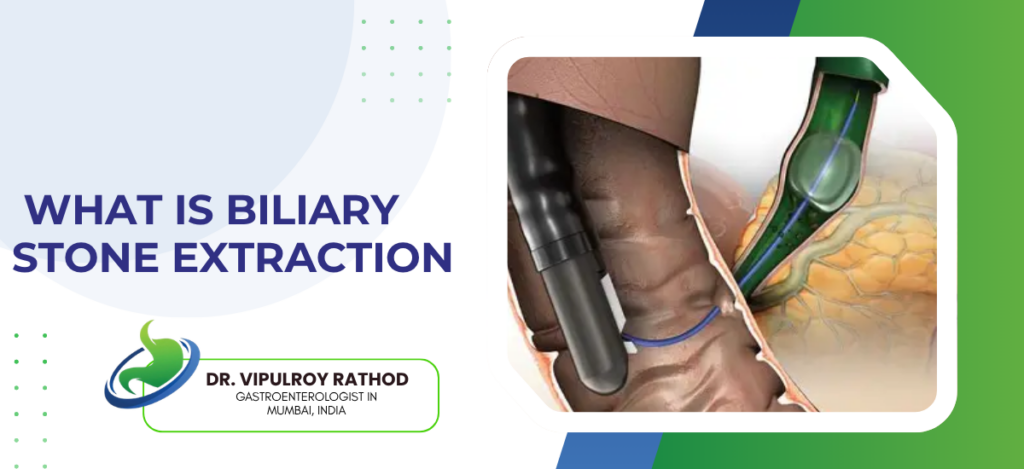
Biliary stone extraction is the process of removing stones that have formed in or migrated into the bile ducts, usually done through an endoscopic procedure called ERCP rather than open surgery. These stones can block bile flow and cause severe pain, jaundice, infection, or pancreatitis if they’re not dealt with, and the endoscopic approach lets gastroenterologists pull them out through the mouth without making a single cut on the body.
According to Dr. Vipulroy Rathod, an experienced Gastroenterologist in Mumbai, “Most patients don’t realise that bile duct stones can be removed through a scope passed through the mouth without any surgery at all, and once they understand that the anxiety around the procedure drops significantly because it’s a same-day intervention with recovery measured in hours not weeks.”
How does the extraction actually happen?
Whole thing goes through a scope while you’re sedated so from your end it’s basically falling asleep and waking up with the stones already out and the duct cleared, which is why most patients can’t believe how quick and straightforward it felt afterwards.
- ERCP: Specialised side-viewing scope goes in through the mouth, down past the stomach, and into the duodenum where the bile duct opens up, and the gastroenterologist uses live X-ray to guide instruments into the duct and find exactly where the stones are parked.
- Sphincterotomy: Small cut at the bile duct opening to widen it enough for stones to actually come through, because without making that opening wider most stones are physically too big to pull out no matter what tools get used or how experienced the operator is.
- Getting the stones out: Balloon catheter sweeps them out or a basket device grabs and drags them through the widened opening depending on size, and most clear in one session though really big or stubborn ones sometimes need cracking apart with mechanical lithotripsy before they’ll budge.
- Stent if needed: When a stone is too large for one go or the duct is too inflamed to push things further a temporary plastic stent goes in to keep bile draining while everything settles, and the patient comes back in a few weeks for round two to finish clearing whatever got left behind.
If you want the full picture of what endoscopic procedures can handle beyond just stone extraction, our advanced endoscopic procedures page covers the complete range of what can be done through a scope without needing anyone to pick up a scalpel.
When does a bile duct stone actually need extracting?
Plenty of gallstones sit in the gallbladder their whole life without bothering anyone, but the moment one drops into the bile duct the game changes completely because that’s when blockages, infections, and pancreatitis all become very real threats that don’t wait around politely.
- Duct blockage: Stone jams in the common bile duct and bile can’t drain anymore, skin and eyes go yellow, urine turns dark, stools go pale, and the longer that stone sits there the higher the chance of a nasty infection building up behind it that can turn dangerous fast.
- Cholangitis: Infected bile duct is a proper emergency because bacteria breed like crazy behind a blocked duct and a patient can go from looking rough to critically septic in a matter of hours, which is why urgent ERCP to yank the stone and drain the infection often happens the same day the diagnosis lands.
- Gallstone pancreatitis: Stone gets stuck at the bottom of the bile duct right where it meets the pancreatic duct and triggers acute pancreatitis, and getting that stone out early with ERCP cuts down both how severe the attack gets and how long the patient spends in hospital recovering from it.
- Stones after gallbladder removal: Some patients end up with bile duct stones even after the gallbladder has already been taken out, and since there’s no gallbladder left to operate on ERCP is basically the only sensible way to clear them without going back in for a much bigger operation that nobody wants.
Biliary complications can pop up from various GI conditions and surgical procedures, and our bile leakage after gallbladder surgery blog covers another post-surgical biliary headache where endoscopic management ends up doing the heavy lifting in both figuring out what went wrong and fixing it.
Why choose Dr. Vipulroy Rathod for biliary stone extraction?
Dr. Vipulroy Rathod has over 30 years in advanced gastroenterology with more than 80,000 endoscopic procedures behind him, and ERCP for stone extraction is one of the most technically demanding scoping procedures out there where the gap between a clean extraction and a messy complicated one usually comes down to whether the person holding the scope has done a few hundred of these or a few thousand.
What patients here notice is that the workup, the ERCP, and the follow-up all run through one specialist instead of being chopped up between a surgeon, a radiologist, and a gastroenterologist who aren’t really talking to each other, because biliary cases that get fragmented across disconnected teams are exactly the ones where miscommunication leads to delays, repeat procedures, and problems that should’ve been caught the first time around.
Book your consultation today with one of India’s most experienced specialists for biliary stone extraction.
Frequently Asked Questions
Biliary stone extraction means removing stones from the bile ducts, usually done through ERCP which is an endoscopic procedure that goes in through the mouth and clears the duct without any surgical cuts on the body at all.
You’re sedated the entire time so you feel absolutely nothing during it, and most patients just have mild throat or belly discomfort afterwards that clears up within a day or so without needing anything more than basic painkillers.
Usually somewhere between 30 minutes and an hour depending on how many stones there are and how tricky they are to get out, with most patients heading home the same day once the sedation has properly worn off.
They can, because new stones sometimes form or drop down from the gallbladder into the duct again after extraction, which is why patients who keep getting them often end up needing the gallbladder taken out to stop the cycle.
Reference links-
- ERCP and Biliary Stone Management — American Society for Gastrointestinal Endoscopy
- Choledocholithiasis Treatment Guidelines — National Library of Medicine
