 Skip to content
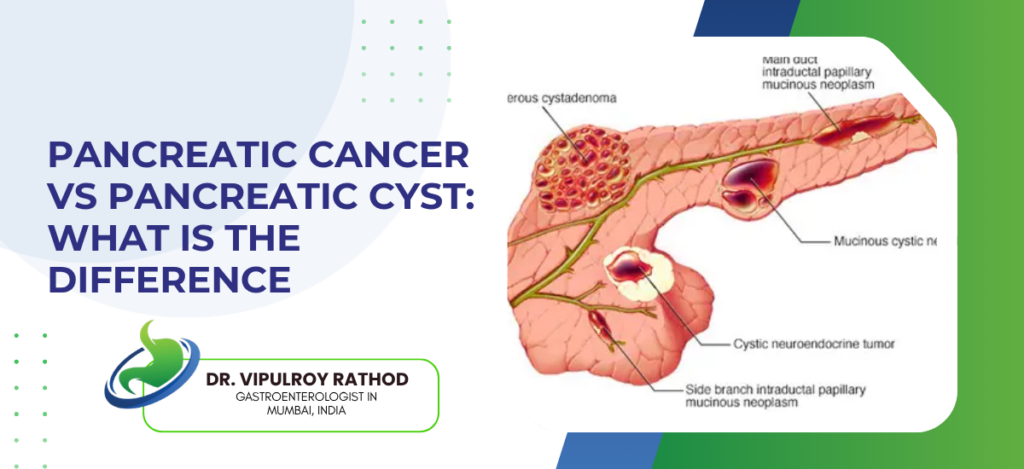
Pancreatic cysts are fluid-filled sacs in or on the pancreas, most are benign and found incidentally on imaging, but some carry malignant potential and need monitoring or treatment. Pancreatic cancer is solid malignant tumour growth in pancreatic tissue, aggressive, and life-threatening when found late.
According to Dr. Vipulroy Rathod, an experienced, Gastroenterologist in Mumbai, “A pancreatic cyst report from a scan does not tell you whether you need to watch it, treat it, or remove it that answer comes from EUS and the specialist reading it, not from the CT report alone.”
How Are Pancreatic Cancer and Pancreatic Cysts Different?
Same organ, completely different pathology. And the consequences of treating one like the other go in both directions.
- What They Are: Pancreatic cancer is solid tumour, malignant from the start, grows and invades surrounding tissue, pancreatic cyst is fluid-filled space, most are benign pseudocysts from prior pancreatitis or serous cystadenomas that carry virtually no cancer risk at all.
- How They’re Found: Cancer usually found because patient has symptoms, weight loss, jaundice, abdominal pain, cysts found incidentally on CT or MRI done for something completely unrelated, patient had no symptoms, no idea the cyst was there.
- Which Cysts Actually Worry Specialists: Serous cystadenomas essentially benign, pseudocysts benign in context of pancreatitis, mucinous cystic neoplasms and IPMNs carry real malignant potential especially when cyst is large, has solid components, or shows worrying ductal features on EUS that plain CT simply doesn’t show.
- Symptoms: Pancreatic cancer causes progressive pain, weight loss, jaundice, new onset diabetes, most pancreatic cysts cause no symptoms at all and produce no clinical signs until they’re either very large or already transforming, which is exactly why active surveillance matters for the right cyst types.
Not all cysts need treatment. Not all cysts are safe to ignore. Specialist in pancreatic cancer treatment knows exactly which category a cyst falls into and what the next step actually is
When Does a Pancreatic Cyst Become a Concern?
Most patients with incidental cysts are told to repeat the scan in six months. That’s not always the right answer.
- Size and Growth Rate: Cysts growing more than 5mm per year or already above 3cm at first detection need proper EUS evaluation not just a repeat CT, growth rate matters as much as absolute size and CT alone doesn’t give you the detail needed to assess wall changes.
- Solid Components Inside the Cyst: Mural nodule inside a cyst changes the risk profile significantly, that finding on EUS moves the clinical decision from surveillance to intervention discussion immediately regardless of cyst size.
- Ductal Involvement: Main pancreatic duct dilation alongside a cyst is a worrying combination, specifically in IPMN cases, and EUS with fine needle aspiration of cyst fluid for CEA and amylase levels gives information no external scan provides.
- Patient Risk Profile: Family history of pancreatic cancer, BRCA2 mutation carrier, chronic pancreatitis history alongside a cyst of uncertain type, that combination changes surveillance frequency and investigation intensity compared to a low-risk patient with a simple serous cyst.
Finding a cyst on a scan is not reassurance. It’s the beginning of an investigation that needs the right specialist. Read more on pancreatic cyst treatment to understand what proper evaluation and management actually involves.
Why Choose Dr. Vipulroy Rathod
Dr. Vipulroy Rathod has been evaluating pancreatic cysts through EUS since 1998, with over 30 years of experience differentiating benign cysts from those with malignant potential using fine needle aspiration, cyst fluid analysis, and EUS morphology that CT cannot replicate. Trained physicians from 35 countries in exactly this pancreatic cyst assessment at Fortis Hospital Mulund. Patients arrive with a cyst report and no idea what it means. Most leave knowing exactly what type of cyst it is, whether it needs treatment, and what monitoring looks like if it doesn’t.
Start Your Treatment Journey Today
Frequently Asked Questions
No. Most pancreatic cysts are benign but certain types like IPMNs and mucinous cysts carry malignant potential and need proper surveillance.
Yes, mucinous cystic neoplasms and main duct IPMNs have significant malignant potential and require regular EUS monitoring or surgical removal.
Cysts appear as fluid-filled spaces on CT while cancer appears as a solid mass, but small cancers and complex cysts need EUS for accurate differentiation.
EUS with fine needle aspiration and cyst fluid analysis for CEA and amylase levels gives the most accurate characterisation of pancreatic cysts.
Reference links-
- Pancreatic Cyst Evaluation Guidelines — American College of Gastroenterology
- Pancreatic Cysts and Malignant Potential — World Gastroenterology Organisation
