
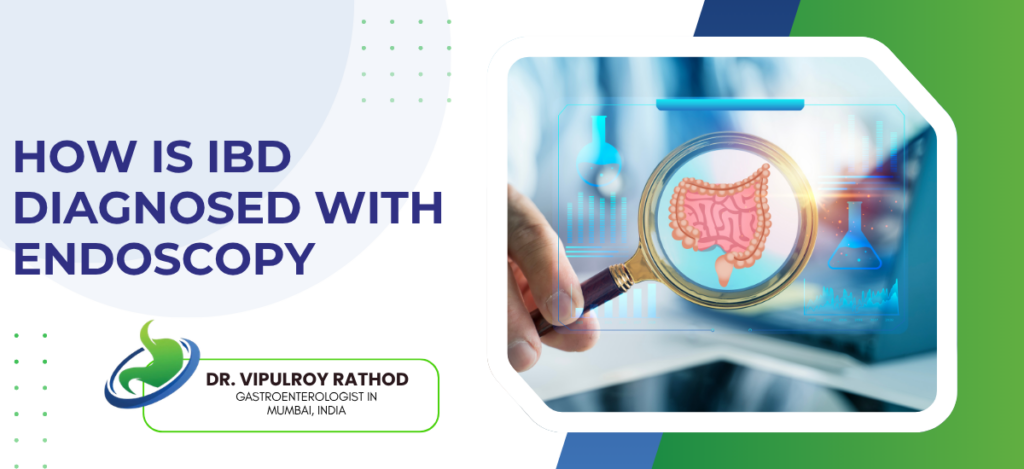
Inflammatory bowel disease can’t be diagnosed on symptoms alone because bloody diarrhoea, abdominal pain, and weight loss show up in a dozen other conditions too. Endoscopy is what actually confirms IBD by letting the gastroenterologist see the bowel lining directly, take biopsies from specific spots, and distinguish between Crohn’s disease and ulcerative colitis based on what the inflammation pattern looks like under the scope and under the microscope.
According to Dr. Vipulroy Rathod, an experienced Gastroenterologist in Mumbai, “Blood tests and stool markers can point you toward IBD but they can’t tell you which type it is or how far it’s spread, and that’s exactly why endoscopy with biopsies remains the gold standard for getting the diagnosis right before committing anyone to years of treatment.”
What does endoscopy actually show in IBD?
Symptoms bring patients to the clinic but the scope is what settles the debate, because until someone looks inside and takes tissue samples everything else is educated guessing at best.
- Mucosal inflammation: The scope shows exactly where the bowel lining is inflamed, whether it’s red and swollen continuously like UC tends to look or patchy with skip lesions and deep ulcers the way Crohn’s typically presents itself.
- Ulceration patterns: Shallow diffuse ulcers running in a continuous stretch suggest UC while deep serpentine or cobblestone ulcers with normal mucosa in between point strongly toward Crohn’s, and these visual patterns are often enough for an experienced endoscopist to have a working diagnosis before biopsies even come back.
- Disease extent: The scope maps out exactly how much bowel is involved which directly affects treatment intensity, because someone with UC limited to the rectum gets managed very differently from someone whose entire colon is lit up with inflammation.
- Biopsies: Tissue samples from multiple sites get sent to pathology where the microscopic pattern confirms what type of IBD is present, picks up granulomas that are almost exclusive to Crohn’s, and rules out infections or other conditions that can mimic IBD on the surface.
If you want to understand what colonoscopy involves as a procedure, our colonoscopy page walks through preparation, sedation, and what happens during and after the scope itself.
Why is endoscopy better than other tests for IBD diagnosis?
Blood work and stool tests are useful starting points but they don’t show what’s happening inside the bowel wall, and imaging gives structural information but can’t take tissue samples which is ultimately what locks in the diagnosis.
- Direct visualisation beats imaging: CT and MRI show wall thickening and complications like abscesses or fistulas but they can’t distinguish between different types of inflammation the way a scope can, and subtle mucosal changes that matter for diagnosis are invisible on any scan no matter how high the resolution.
- Biopsies are irreplaceable: No blood test or imaging study can provide the histological confirmation that pathology offers, and separating Crohn’s from UC from infectious colitis from ischaemic changes requires tissue under a microscope which only comes from an endoscope.
- Therapeutic decisions depend on scope findings: Whether a patient starts on aminosalicylates or goes straight to biologics often depends on what the scope showed in terms of disease extent and severity, because a mild proctitis and a pancolitis with deep ulceration don’t get treated the same way even though the symptoms might overlap significantly.
- Monitoring and surveillance: Endoscopy isn’t just for initial diagnosis because IBD patients need periodic re-scoping to check whether treatment is achieving mucosal healing, catch dysplasia early in longstanding disease, and adjust the management plan based on how the bowel actually looks rather than just how the patient feels.
Advanced endoscopic techniques keep expanding what’s possible in GI diagnostics and treatment, and our EUS celiac plexus neurolysis blog covers another example of how interventional endoscopy is being used to manage complex conditions that previously required open surgical approaches.
Why choose Dr. Vipulroy Rathod for IBD diagnosis?
Dr. Vipulroy Rathod has over 30 years in advanced gastroenterology with more than 80,000 endoscopic procedures behind him, and IBD diagnosis specifically requires the kind of endoscopist who’s scoped enough colons to recognise subtle patterns that less experienced operators might write off as nonspecific inflammation or miss entirely during a routine pass through the bowel.
What patients get here is a proper diagnostic workup where the scope findings, biopsy results, and clinical picture all get pulled together into one clear answer before any long-term treatment gets started, because putting someone on years of immunosuppression without being certain of the diagnosis is exactly the kind of mistake that careful initial scoping exists to prevent.
Book your consultation today with one of India’s most experienced specialists for IBD evaluation.
Frequently Asked Questions
Blood tests and stool markers can raise suspicion but endoscopy with biopsies remains the only way to definitively confirm IBD, determine which type it is, and assess how much of the bowel is involved.
The procedure is done under sedation so patients feel nothing during it, and most experience only mild bloating or discomfort afterwards that typically clears within a day.
Frequency depends on disease activity and duration, with newly diagnosed patients needing follow-up scopes to assess treatment response and longstanding cases needing surveillance every 1 to 3 years for dysplasia screening.
UC typically shows continuous inflammation starting from the rectum while Crohn’s presents with patchy skip lesions, deeper ulcers, and sometimes cobblestoning, with biopsy confirmation being the final step in telling them apart.
Reference links-
- IBD Diagnosis and Endoscopy Guidelines — American College of Gastroenterology
- Endoscopic Assessment in Inflammatory Bowel Disease — National Library of Medicine
