 Skip to content
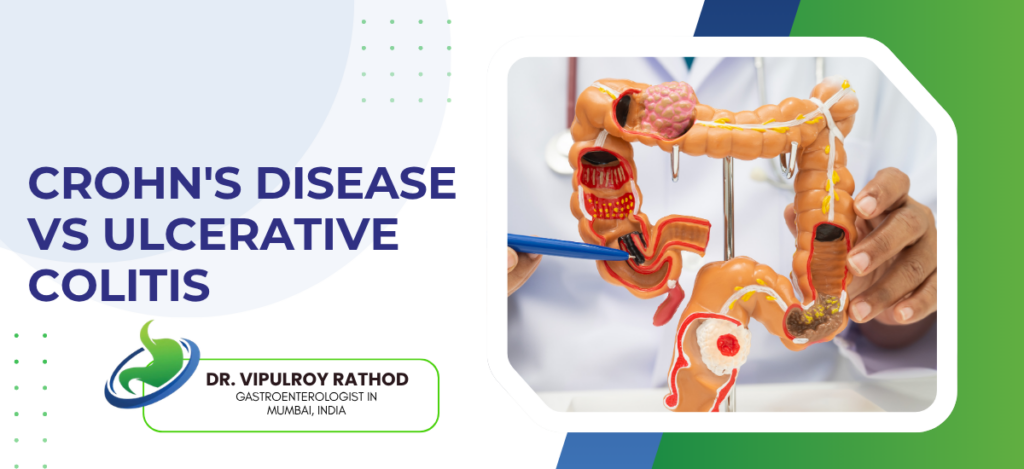
Both fall under inflammatory bowel disease but Crohn’s and ulcerative colitis are not the same condition despite getting lumped together constantly. Crohn’s can hit any part of the digestive tract from mouth to anus and digs deep into the bowel wall, while UC sticks to the colon and rectum and only affects the innermost lining. The distinction matters because treatment decisions, surgical options, cancer surveillance timelines, and long-term outlook all change depending on which one you’re actually dealing with.
According to Dr. Vipulroy Rathod, an experienced Gastroenterologist in Mumbai, “Getting the diagnosis wrong between Crohn’s and UC early on leads to years of treatment that doesn’t quite work the way it should, which is why the initial workup needs to be thorough enough to tell them apart properly before any long-term medication plan gets locked in.”
How do Crohn's and ulcerative colitis differ?
They share enough symptoms to trip up patients and honestly sometimes even doctors, but once you look at where the inflammation sits and how deep it goes and what pattern it follows the two start looking like very different animals.
- Location: UC only hits the colon and rectum in one continuous stretch working upward from the bottom, while Crohn’s can pop up literally anywhere from the mouth to the anus with the terminal ileum being the spot it seems to like the most.
- Depth: UC stays shallow on the mucosal surface which is why it rarely causes structural damage, while Crohn’s burrows through the full thickness of the bowel wall and that’s exactly how fistulas, abscesses, and strictures end up happening.
- Pattern: UC spreads in one unbroken patch with no healthy gaps in between, while Crohn’s does the skip lesion thing where inflamed chunks alternate with stretches of bowel that look completely normal sitting right next to them.
- Rectum: UC almost always starts there and works its way up which is actually one of the diagnostic giveaways, while Crohn’s frequently skips the rectum entirely and can affect isolated segments further up without touching the lower end at all.
If persistent bowel symptoms have you wondering what a diagnostic scope involves, our colonoscopy page covers the full procedure including prep and what the gastroenterologist is actually hunting for while they’re in there.
Why does getting the right diagnosis matter so much?
Treating one like the other doesn’t just waste time it can genuinely make things worse, because the drugs that work, the surgical strategies available, and the monitoring schedules are not interchangeable between these two even though they get talked about like they are.
- Medication: Both use overlapping drug classes but the specific agents and dosing strategies differ since certain medications that knock UC into remission barely dent Crohn’s and the reverse is also true, which is why prescribing without a confirmed diagnosis is basically a coin flip.
- Surgery: UC can technically be cured by taking the entire colon out since the disease doesn’t exist anywhere else, while Crohn’s can’t be cured surgically because it has this annoying habit of coming back in completely different parts of the gut even after the sick section has been removed.
- Cancer risk: Both raise colorectal cancer risk after 8 to 10 years of colonic involvement but surveillance protocols differ based on how much colon is affected, how bad the inflammation has been running, and whether primary sclerosing cholangitis is sitting alongside the IBD adding extra risk.
- Complications: Crohn’s patients deal with fistulas, abscesses, and strictures that can mean repeated trips to the operating table over a lifetime, while UC complications tend to revolve around severe flares, toxic megacolon, and bleeding episodes that usually get sorted medically or with one definitive surgery.
Metabolic conditions running alongside IBD can throw extra wrenches into management, and our fatty liver and diabetes blog covers how overlapping metabolic problems interact with chronic GI conditions in ways that genuinely affect treatment planning and what kind of outcomes patients can realistically expect.
Why choose Dr. Vipulroy Rathod for IBD diagnosis and management?
Dr. Vipulroy Rathod has spent over 30 years in advanced gastroenterology with more than 80,000 endoscopic procedures behind him, and IBD cases make up a significant chunk of that because telling Crohn’s from UC during endoscopy requires the kind of pattern recognition you only build from scoping thousands of colons over decades and not from reading about it in a textbook.
What patients here get is a proper diagnostic workup finished before any long-term treatment plan gets started, because locking someone into years of medication without being sure which type of IBD they’ve actually got is exactly how suboptimal management happens and that’s something this clinic goes out of its way to avoid by getting the diagnosis sorted out first.
Book your consultation today with one of India’s most experienced specialists for IBD evaluation.
Frequently Asked Questions
Neither is universally worse since both can range from mild to severe, though Crohn’s tends to cause more structural complications like fistulas and strictures while UC carries a higher risk of acute severe flares requiring emergency intervention.
No, they are separate conditions caused by different disease processes, though in about 10 percent of cases the initial diagnosis may get reclassified as more information becomes available over time.
Diagnosis involves colonoscopy with biopsies, imaging like MRI enterography, blood and stool markers, and clinical assessment of symptom patterns, with the combination of findings usually pointing clearly toward one condition over the other.
UC can technically be cured by removing the entire colon surgically, while Crohn’s has no surgical cure because it can recur anywhere in the digestive tract even after the affected section has been taken out.
Reference links-
- Inflammatory Bowel Disease Management Guidelines — American College of Gastroenterology
- Crohn’s Disease and Ulcerative Colitis Clinical Evidence — National Library of Medicine
