 Skip to content
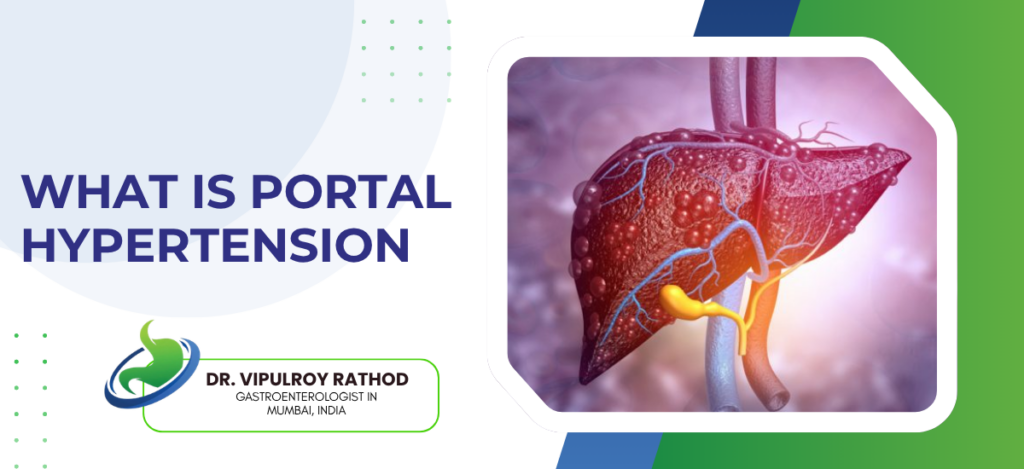
Portal hypertension is elevated blood pressure (typically >10 mmHg) within the portal venous system, which carries blood from the digestive organs to the liver. It is most commonly caused by liver cirrhosis (scarring), which blocks blood flow, forcing blood into smaller veins, causing them to enlarge and potentially burst.
According to Dr. Vipulroy Rathod, an experienced Gastroenterologist in Mumbai, “Portal hypertension is really the engine behind most of the dangerous complications we see in cirrhosis patients, and understanding that connection is what allows us to get ahead of things like variceal bleeding before they turn into emergencies.”
Why does portal pressure go up in the first place?
Think of it like a pipe getting slowly clogged. Blood from the gut needs to pass through the liver but when the liver is scarred or blocked that blood has got nowhere to go except backwards and sideways into veins that were never built for that kind of traffic.
- Cirrhosis: Scarring chokes off the channels blood flows through inside the liver, and the worse it gets the more pressure keeps climbing which is why pretty much every patient with advanced cirrhosis winds up dealing with this eventually.
- Portal vein clot: Thrombus forming right inside the vein blocks flow before blood even reaches the liver, usually turning up in patients with clotting issues or after abdominal surgery where the venous plumbing near the liver got roughed up.
- Schistosomiasis: Parasitic infection that scars up portal branches inside the liver and still ranks as a top cause worldwide even though gastroenterologists in Indian cities run into cirrhosis-driven cases way more often in their regular clinics.
- Other causes: Budd-Chiari, idiopathic portal hypertension, and a few rarer conditions where pressure goes up without any obvious scarring or clot sitting there, which is exactly why the workup can’t just assume cirrhosis and stop looking.
If you’ve been told you have liver disease or portal hypertension, our liver cirrhosis treatment page lays out what medical and endoscopic options look like depending on what’s behind the pressure and how far things have already gone.
What gets done about it once it's found?
Depends completely on what’s already happened because handling someone with varices that haven’t bled yet is a totally different situation from someone who’s already had blood coming up or whose belly keeps filling with fluid that won’t go away no matter what gets thrown at it.
- Beta blockers: Propranolol or carvedilol usually come first to slow the heart and cut blood flowing into the portal system, bringing pressure down enough that varices don’t hit the point where they pop open.
- Banding: When varices have ballooned up enough to be properly dangerous an endoscopist puts bands on through a scope to tie them off so they shrink down, works both as prevention and as emergency treatment when someone is actively losing blood.
- Draining the belly: Diuretics and salt restriction handle the milder end of ascites but when the belly keeps swelling despite everything a needle goes in to pull fluid out directly, especially once it’s gotten bad enough to squash the lungs and make breathing a struggle.
- TIPS: Bypass channel built inside the liver through a catheter to reroute blood and drop pressure directly, kept in the back pocket for patients whose varices keep reopening or whose ascites flat out refuses to respond to anything else that’s been tried.
Endoscopic tools sit right at the core of how these complications get dealt with, and our achalasia and POEM blog covers another GI condition where advanced endoscopy completely took over from open surgery showing how that same minimally invasive thinking works across problems that look nothing alike on paper.
Why choose Dr. Vipulroy Rathod for portal hypertension management?
Dr. Vipulroy Rathod has been at gastroenterology and hepatology for over 30 years now with more than 80,000 endoscopic procedures done, and variceal banding alone makes up a big piece of that because managing portal hypertension well means having been through enough bleeds and emergency scopes to read the situation right every time it comes up rather than figuring it out on the fly.
What patients keep bringing up is that imaging, labs, and scope findings all land in one plan from one team instead of getting scattered across departments that aren’t coordinating with each other, because when something hits this many systems at once having the care fragmented across multiple disconnected teams is exactly how important things end up getting missed.
Book your consultation today with one of India’s most experienced specialists for portal hypertension evaluation.
Frequently Asked Questions
Portal hypertension is abnormally high pressure in the portal vein usually caused by liver cirrhosis, leading to complications like variceal bleeding, ascites, and splenomegaly that need specialist management.
Most patients don’t feel the pressure itself but notice its effects through abdominal swelling from fluid buildup, vomiting blood from ruptured varices, or an enlarged spleen picked up on imaging.
Treating the underlying cause like cirrhosis or a portal vein clot can reduce pressure over time, but in many cases management focuses on preventing and controlling complications rather than eliminating the condition entirely.
Varices are managed with beta blockers to reduce pressure and endoscopic band ligation to physically tie off swollen veins, with TIPS reserved for cases that don’t respond to standard medical and endoscopic treatment.
Reference links-
- Portal Hypertension Management Guidelines — American Association for the Study of Liver Diseases
- Variceal Bleeding and Portal Hypertension — National Library of Medicine
