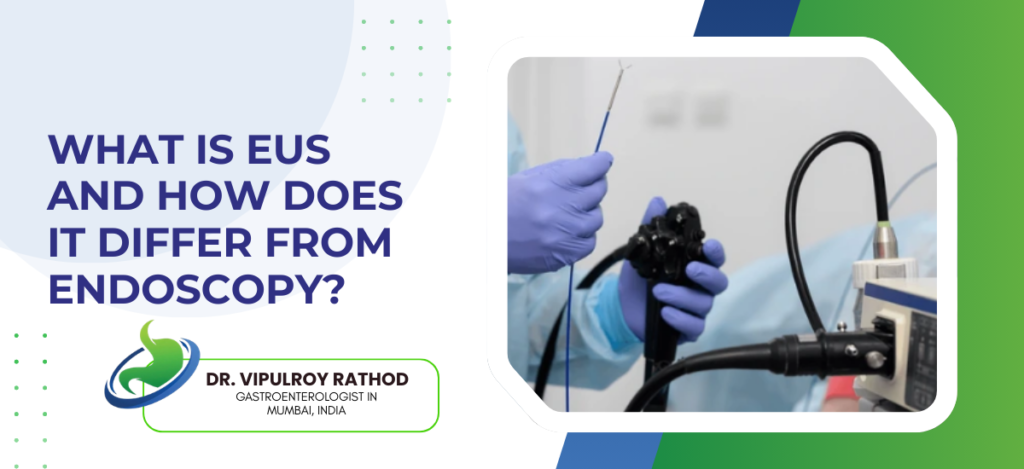
EUS Endoscopic Ultrasound combines a standard endoscope with an ultrasound probe at the tip. It goes into the digestive tract the same way a regular endoscopy does. But instead of just looking at the surface, it images the layers beneath and the organs sitting right outside the gut wall.
According to Dr. VipulRoy,
“Endoscopic Ultrasound is not an upgraded endoscopy. It’s a different investigation entirely. Endoscopy tells you what the lining looks like. EUS tells you what’s happening underneath it and in the organs immediately behind it.”
What Standard Endoscopy Actually Does?
Regular endoscopy is incredibly useful. Don’t get that wrong. But it has a clear limit. It shows your doctor the inner lining of your digestive tract. That’s it. What’s beyond that lining stays invisible.
- It examines the surface lining only Standard endoscopy spots ulcers, inflammation, bleeding, and surface polyps well. But anything sitting beneath the gut wall or in nearby organs simply doesn’t show up at all.
- It’s the right tool for many common conditions Colonoscopy and upper GI endoscopy diagnose GERD, gastritis, IBD, and colorectal polyps effectively. For surface-level problems endoscopy is exactly what you need.
- Biopsies from the surface are possible Tissue samples from the gut lining get taken during standard endoscopy. But deeper lesions sitting beneath the surface or in the pancreas? That requires something more powerful entirely.
- It can’t evaluate your pancreas or bile duct This is the biggest limitation. The pancreas and bile duct sit behind and beside the gut wall. Standard endoscopy can’t reach or image them with any real diagnostic clarity for you.
Know more about how EUS works for your specific situation at Gastroenterology specialist in mumbai.
What EUS Does That Endoscopy Simply Can't?
EUS combines a flexible endoscope with a high-frequency ultrasound probe at its tip. It goes inside your digestive tract. Then it uses ultrasound to see through the wall and into surrounding structures. That combination is genuinely powerful.
- It images the pancreas from inside your stomach wall The pancreas is notoriously difficult to see from outside the body. EUS reaches it directly from inside and gives image clarity that no CT scan or MRI consistently matches for early lesions.
- It evaluates all layers of your gut wall Endoscopic Ultrasound shows every individual layer of your digestive tract wall. Submucosal tumours hiding beneath the surface get identified and assessed precisely here.
- EUS-guided biopsy reaches deep tissue Tissue samples from the pancreas, lymph nodes, and bile duct get collected through EUS-guided fine needle aspiration. No surgery. No incisions. Just accurate targeted sampling exactly where it’s needed.
- Cancer staging happens in real time Tumour depth, vascular involvement, and lymph node status get assessed during the same EUS session. Your oncologist gets the precise information they need immediately from one focused procedure.
For more on why EUS expertise changes diagnostic outcomes, read our previous blog on Best Gastroenterologist in Mumbai for Pancreatic Cancer Diagnosis.
Why Choose Dr. VipulRoy Rathod for EUS in Mumbai?
Dr. Vipulroy Rathod has spent over 25 years building a level of EUS expertise that most gastroenterologists in India simply haven’t developed. He’s India’s first FASGE fellow. He’s trained doctors from 35 countries. And honestly? Patients who arrive after months of inconclusive standard endoscopy results leave with real answers after one properly performed EUS session. That’s what the right specialist actually does for you.
Think you could benefit from specialized care? Reach out today to explore your treatment options.
Frequently Asked Questions
No. Both serve different purposes. Standard endoscopy handles surface conditions well. EUS goes deeper for complex cases that endoscopy simply can’t evaluate properly.
Both are done under sedation. Most patients feel no difference in comfort level between the two procedures at all.
When symptoms suggest pancreatic, biliary, or submucosal problems that regular endoscopy can’t evaluate clearly enough for a confident diagnosis.
Standard endoscopy takes around 15 to 20 minutes. EUS takes 30 to 45 minutes depending on complexity of your specific case.
References links
- Endoscopic Ultrasound Overview — American Society for Gastrointestinal Endoscopy
- EUS vs Standard Endoscopy — National Library of Medicine
- Diagnostic Endoscopy Guidelines — American College of Gastroenterology
- Advanced Endoscopy Clinical Overview — World Gastroenterology Organisation