
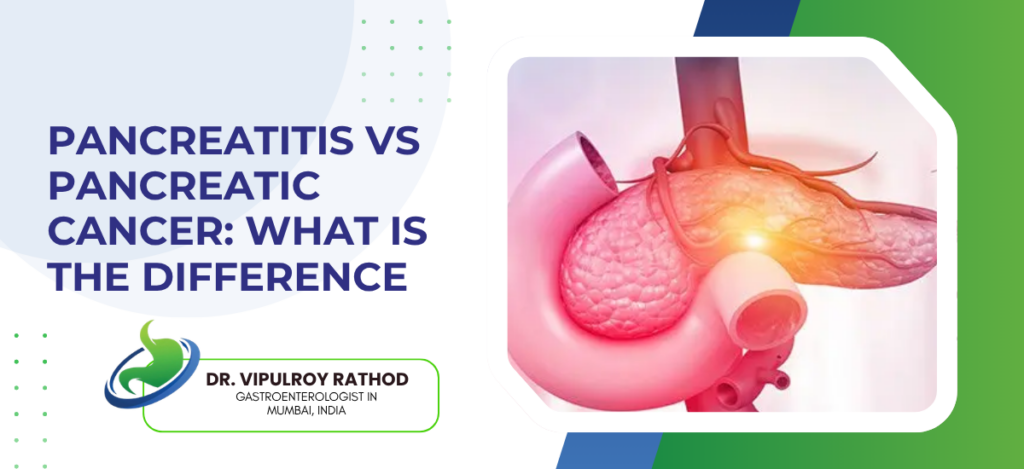
Pancreatitis is inflammation of the pancreas, acute or chronic, caused by gallstones, alcohol, or other triggers, treatable and often reversible. Pancreatic cancer is malignant tumour growth in pancreatic tissue, progressive, life-threatening if not caught early. Both cause upper abdominal pain, nausea, and weight loss which is why they get confused constantly. Key difference: pancreatitis responds to treatment and stabilises, pancreatic cancer progresses regardless and needs urgent investigation.
According to Dr. Vipulroy Rathod, an experienced Gastroenterologist in Mumbai, “Pancreatitis and pancreatic cancer overlap in symptoms enough that patients get treated for one while actually having the other, and that diagnostic gap costs time nobody can afford when cancer is the actual problem.”
How Are Pancreatitis and Pancreatic Cancer Different?
Same organ. Completely different disease processes. And the consequences of mixing them up are not small.
- What Causes Each: Pancreatitis has identifiable triggers in most cases, gallstones, alcohol, certain medications, high triglycerides, pancreatic cancer often shows up with no obvious cause the patient or their doctor thought to question.
- Pain behaves differently: Pancreatitis pain is episodic, severe, radiates to back, improves with fasting, pancreatic cancer pain is relentless and progressive, doesn’t improve with diet changes or treatment, just keeps getting worse until someone investigates properly.
- Amylase and lipase spike dramatically in acute pancreatitis. In pancreatic cancer both are often completely normal. CA 19-9 elevated in cancer but also in benign conditions. Ordering only the wrong blood panel and stopping there is how cancer gets missed for months in patients who look like they have pancreatitis.
- Imaging: CT shows swelling and fluid in pancreatitis, calcifications in chronic cases, pancreatic cancer shows mass but sub-2cm tumours are missed on CT routinely, need EUS to actually find them.
Getting the right diagnosis from the start changes everything that follows. Specialist in pancreatitis treatment investigates both possibilities properly rather than defaulting to the easier diagnosis.
What Does Endoscopy Treat in Digestive Diseases?
These patterns keep getting missed. Worth knowing what to flag.
- Idiopathic: No identifiable trigger for pancreatitis, no alcohol, no gallstones, no medication, symptoms still present. That combination needs cancer ruled out before pancreatitis gets managed as standalone condition and the real problem stays hidden another six months.
- Weight loss that doesn’t stop: Pancreatitis weight loss stabilises once inflammation treated. Progressive weight loss continuing despite treatment is not a pancreatitis pattern. Needs EUS.
- New-Onset DiabetesNew diabetes appearing at same time as upper GI symptoms in patient over 50 with no metabolic risk factors. Tumour disrupting insulin-producing tissue. Gets filed under endocrine disease. Pancreas never checked.
- First acute episode after 50 with no cause: Needs EUS to rule out cancer before pancreatitis gets treated as standalone. Not after three months of management. Before.
Pancreatitis that doesn’t behave like pancreatitis needs a second look before more treatment goes in the wrong direction. Read more on advanced GI procedures without open surgery to understand what proper investigation looks like.
Why Choose Dr. Vipulroy Rathod
Dr. Vipulroy Rathod has over 30 years of experience distinguishing pancreatitis from pancreatic cancer in cases where standard imaging leaves uncertainty, with EUS expertise since 1998 that helps detect malignancies hidden behind inflammatory disease even when CT scans and blood tests appear inconclusive. He has trained physicians from 35 countries in this specialised diagnostic approach at Fortis Hospital Mulund. Patients often arrive after being treated for pancreatitis for months while an underlying condition remains undetected, and identifying that missed diagnosis is a key part of his clinical expertise.
Start Your Treatment Journey Today
Frequently Asked Questions
Chronic pancreatitis increases pancreatic cancer risk over time but most pancreatitis cases do not progress to cancer.
EUS, CT, MRI, blood tests including CA 19-9, amylase, and lipase, and clinical pattern together differentiate the two conditions accurately.
Not always early on. Pain becomes more consistent as disease progresses and tumour compresses surrounding nerves and structures.
Can pancreatitis and pancreatic cancer occur together?
Yes, chronic pancreatitis can coexist with pancreatic cancer and the pancreatitis can actually mask the cancer making diagnosis harder.
Can pancreatitis and pancreatic cancer occur together?
Yes, chronic pancreatitis can coexist with pancreatic cancer and the pancreatitis can actually mask the cancer making diagnosis harder.Can pancreatitis and pancreatic cancer occur together?
Yes, chronic pancreatitis can coexist with pancreatic cancer and the pancreatitis can actually mask the cancer making diagnosis harder.
Yes, chronic pancreatitis can coexist with pancreatic cancer and the pancreatitis can actually mask the cancer making diagnosis harder.
Reference links-
- Pancreatitis and Pancreatic Cancer Differentiation — American College of Gastroenterology
- Pancreatic Disease Diagnosis Guidelines — World Gastroenterology Organisation