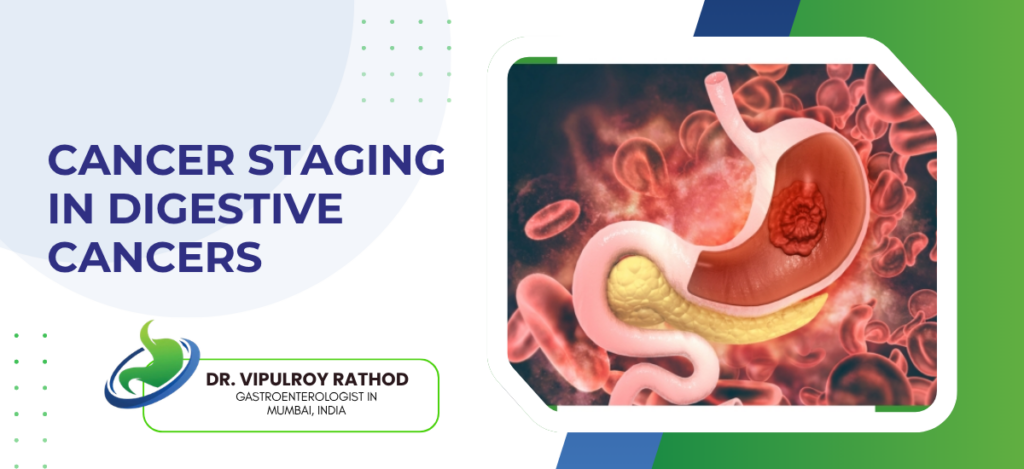
Cancer staging in digestive cancers uses the TNM system to classify how far cancer has spread: T for tumour depth into the organ wall, N for lymph node involvement, M for distant metastasis. Stage 1 is localised, Stage 4 means spread to distant organs like liver or lungs. Staging directly decides whether surgery is possible, what treatment sequence applies, and what realistic outcomes look like for each patient.
According to Dr. Vipulroy Rathod, an experienced Gastroenterologist in Mumbai,
“Most patients arrive with a stage assigned from a CT report done in a hurry and that stage is frequently wrong EUS changes T and N staging in a significant proportion of GI cancer cases and the treatment changes with it.”
Why Does Accurate Staging Change Everything?
Wrong stage means wrong treatment. Simple as that. Here’s where staging errors actually happen.
- CT Misses Small Nodal Deposits: Standard CT regularly misses lymph node involvement in early GI cancers because nodes need to be visibly enlarged to show up, and small deposits in normal-sized nodes are exactly what EUS finds and CT doesn’t.
- T Stage Gets Underestimated on CT: Tumour depth into the organ wall is consistently harder to assess from outside the body, and understaging the T component means patients get offered endoscopic resection for a tumour that has already gone deeper than the scan suggested.
- Restaging After Treatment Gets Skipped: After chemotherapy or radiation the tumour needs restaging before surgery is reconsidered, this step gets skipped more often than it should and patients go into surgery without anyone confirming what the treatment actually did to the tumour.
- Stage 4 Gets Missed Early: Small liver metastases and peritoneal deposits are regularly absent on initial staging scans and show up later, which is why high-risk cases need more thorough staging workup not just a single CT before treatment decisions get made.
Staging isn’t a one-time checkbox. Read more on POEM procedure to understand how advanced endoscopic procedures work alongside cancer staging in GI management.
How Does Diabetes Increase Pancreatic Disease Risk?
Alcohol is a Group 1 carcinogen. No safe level for cancer risk has been established and the GI tract takes the most direct hit of any organ system.
- Liver Cancer Through Cirrhosis: Chronic alcohol use causes cirrhosis and cirrhosis is the strongest single risk factor for hepatocellular carcinoma, cirrhotic patients carry a 1 to 5% annual liver cancer risk regardless of whether they’ve stopped drinking by that point.
- Colorectal Cancer, Even Moderate Drinking: Risk rises linearly with consumption and even 1 to 2 drinks per day is associated with measurably increased colorectal cancer risk in large population studies, something most patients are genuinely surprised to hear when told directly.
- Oesophageal Cancer with Smoking Combined: Alcohol and tobacco act synergistically on oesophageal tissue and the combined risk is multiplicative not additive, heavy drinkers who smoke sit in a risk category that justifies regular upper endoscopy surveillance rather than waiting for symptoms to show up.
- Stomach Cancer Through Mucosal Damage: Alcohol directly damages gastric mucosal lining and chronic exposure creates persistent inflammation that increases H. pylori susceptibility and accelerates the gastritis to cancer progression sequence faster than either factor alone.
Both together are worse than either alone and risk doesn’t reset quickly after stopping. Read more on AI in GI endoscopy to understand how modern detection tools are changing early cancer surveillance.
Why Choose Dr. Vipulroy Rathod
Dr. Vipulroy Rathod has 30 years in gastroenterology, EUS since 1998, trained physicians from 35 countries. Stages GI cancers at Fortis Hospital Mulund with EUS accuracy that CT-dependent workups consistently miss and has seen enough staging errors from outside referrals to know exactly where the gaps are. Patients arrive with a stage. Gets verified here before anyone commits to a treatment plan. That’s the difference between right treatment and expensive wrong treatment.
Start Your Treatment Journey Today
Frequently Asked Questions
TNM describes tumour depth, lymph node involvement, and distant metastasis to classify how far digestive cancer has spread.
Yes in some cases, Stage 3 cancers with lymph node involvement can still be treated with combined chemotherapy, radiation, and surgery.
EUS images from inside the GI tract giving millimetre-level accuracy for tumour depth and nearby lymph nodes that CT misses regularly.
Yes, restaging after chemotherapy or radiation is standard to assess tumour response before surgery is reconsidered.
Reference links-
- GI Cancer Staging Guidelines — American College of Gastroenterology
- Digestive Cancer TNM Staging — World Gastroenterology Organisation