
Artificial Intelligence (AI) has made significant advancements across various fields, revolutionizing healthcare with its potential to improve diagnoses and treatment outcomes. In gastroenterology, AI is particularly transforming gastrointestinal (GI) endoscopy by assisting with real-time analysis of endoscopic images, leading to earlier and more accurate detection of diseases, including cancer. AI algorithms are designed to recognize patterns and abnormalities that the human eye may miss, offering a new level of precision in GI endoscopy.
AI in GI Endoscopy is particularly promising for detecting GI cancers, including esophageal, gastric, and colorectal cancers. Dr. Vipulroy Rathod, a globally acclaimed gastroenterologist in Mumbai, explains, “AI integration in GI endoscopy has the potential to significantly enhance cancer detection, reducing human error and improving patient outcomes.” His expertise in advanced endoscopic techniques ensures that AI is used effectively to detect and treat GI cancers.
What exactly is AI in GI Endoscopy and how is it integrated into endoscopic procedures? Let’s break it down.
What Is AI in GI Endoscopy?
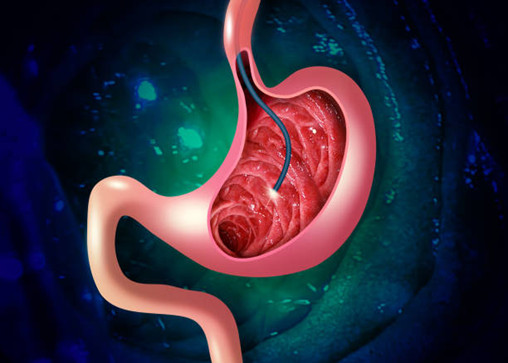
AI in GI endoscopy technology uses machine learning algorithms and deep learning models to analyze endoscopic images in real time. These AI systems are trained to recognize patterns and anomalies in gastrointestinal tissues to identify various growths, polyps, or early signs of cancer. The AI software used to analyze images from the endoscopic camera provides instant feedback to the gastroenterologist.
How AI Is Integrated Into Endoscopic Procedures:
Real-Time Image Analysis
AI algorithms process the endoscopic images captured during the procedure and highlight potential areas of concern, helping doctors focus on abnormal findings.
Pattern Recognition
The AI system is trained on a vast database of images from various sources to identify common and rare abnormalities, thereby helping detect cancer or precancerous lesions.
Automated Reporting
After the procedure, AI can automatically generate reports, summarizing the findings and assisting in making more informed treatment decisions.
Now, let’s discuss the importance of early diagnosis of GI cancers.
Why Early Cancer Detection Matters
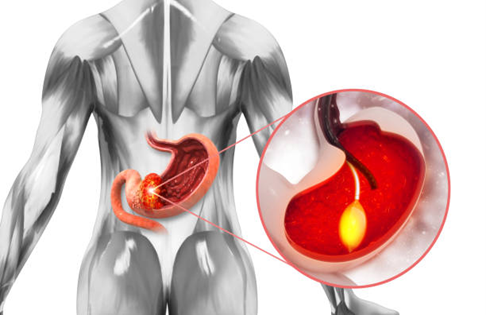
How exactly does AI help in detecting cancers during GI endoscopy? Let’s break it down.
How AI Assists in Detecting GI Cancers
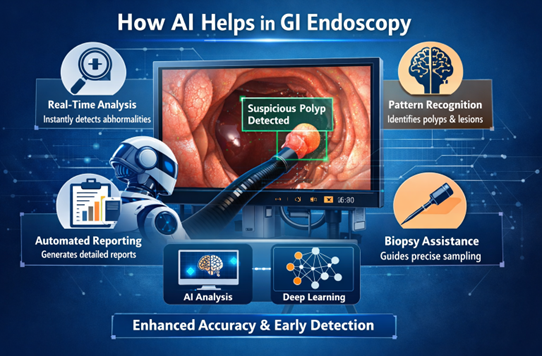
AI plays a pivotal role in improving the accuracy and efficiency of cancer detection during GI endoscopy. Here’s how AI enhances the detection process:
Identifying Small Lesions
AI algorithms can detect small or subtle lesions that may be overlooked by human eyes, particularly during routine screening procedures.
Precancerous Lesions
AI can distinguish between benign growths and precancerous lesions, allowing for earlier intervention.
Consistent Performance
AI maintains a high level of consistency in analyzing images, since there is less scope for variations that may occur, as perceived by different operators or procedures.
Assisting in Biopsy Guidance
AI can assist endoscopists in guiding biopsy tools to the precise location of suspicious areas for further examination.
What are the key benefits of integrating AI into GI endoscopy? Let’s explore the advantages.
Key Benefits of Using AI in GI Endoscopy

Improved Accuracy
AI helps identify abnormalities more accurately, reducing the chances of missed diagnoses.

Early Detection
By identifying early signs of cancer and precancerous states, AI can enable quicker intervention.

Faster Results
With real-time analysis, AI provides immediate feedback, enabling rapid diagnosis of the problem.

Enhanced Efficiency
AI can automate routine tasks such as image review, freeing up the gastroenterologist’s time to focus on patient care.

Consistency
Consistent results can be obtained through AI systems, reducing the probability of human error and variability.
Current Limitations and Challenges of AI in GI Endoscopy
While AI in GI endoscopy holds promise, challenges also exist.
1. Data Quality
AI depends on large databases for training and the kind of datasets it uses may affect the quality of its performance.
2. Integration with Existing Systems
Integrating AI tools into existing endoscopic systems can be a challenging task from the technical viewpoint.
3. Dependence on Expert Supervision
AI cannot replace the gastroenterologist's expertise and should be used as a complementary tool.
4. Limited Generalization
This may be because AI systems trained on a single dataset may not generalize well to other datasets, and there may be discrepancies in the diagnosis across populations.
5. Regulatory and Ethical Issues
This also creates several issues with accountability, transparency and regulation in terms of AI's use in medical procedures.
What does the clinical evidence say about the accuracy of AI endoscopy cancer detection?
Clinical Evidence and Accuracy of AI-Assisted Cancer Detection
Studies have shown that AI can significantly improve the accuracy of GI cancer detection. In trials, AI-assisted endoscopy demonstrated higher sensitivity and specificity in detecting early-stage cancers compared to traditional methods.
AI algorithms have been shown to correctly identify abnormalities with a level of accuracy comparable to that of highly experienced endoscopists. In some cases, AI has outperformed human operators in detecting subtle lesions or precancerous changes.
What does the future hold for AI in GI endoscopy? Let’s look ahead.
What does the future hold for AI in GI endoscopy? Let’s look ahead.
Future Scope of AI in GI Endoscopy
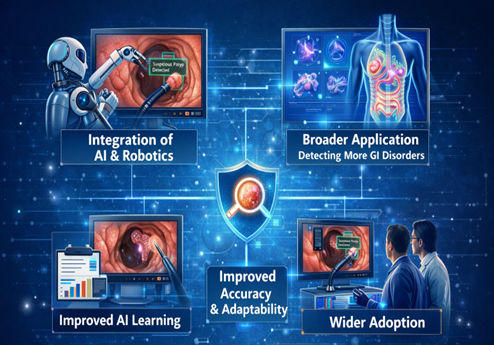
The future of using AI in GI endoscopy looks incredibly promising. With continued progress in the development of AI, we may expect:
Integration of AI with Other Technologies
AI will likely be combined with other technologies, such as robotics and augmented reality, to enable even more precise procedures.
Broader Application
AI could potentially extend to identify more GI disorders beyond cancer, improving overall diagnostic capabilities.
Improved Learning Algorithms
Ongoing developments in machine learning will enhance AI’s ability to detect more complex abnormalities and adapt to new data sources.
Wider Adoption
With continued development and clinical validation, AI tools will become more accessible and widely used in clinical settings.
Conclusion
AI in GI endoscopy is transforming cancer detection by improving accuracy, enabling earlier detection, and improving patient outcomes. As technology advances, it will continue to play a pivotal role in diagnosing and treating GI cancers.
Dr. Vipulroy Rathod’s expertise in using AI-enhanced endoscopy ensures that his patients receive the most advanced care available. Early detection through AI can help significantly improve cancer survival rates, allowing for better treatment outcomes.
Frequently Asked Questions
Yes, clinical evidence shows that AI-assisted endoscopy can improve the accuracy of cancer detection, sometimes outperforming human operators.
AI can help detect colorectal, esophageal, and gastric cancers during endoscopic procedures.
AI analyzes endoscopic images in real time, highlighting potential areas of concern for the gastroenterologist to focus on.
AI can identify small, subtle changes in tissues that might be missed by human operators, allowing for earlier treatment.
Yes, AI may eventually be used to detect a wider range of GI issues, such as inflammatory bowel diseases, polyps, and other abnormalities.
Reference links:
https://www.wjgnet.com/2689-7164
https://www.sciencedirect.com/science/article/pii/S168719792300120X
Disclaimer: The information shared in this content is for educational purposes and not for promotional use.