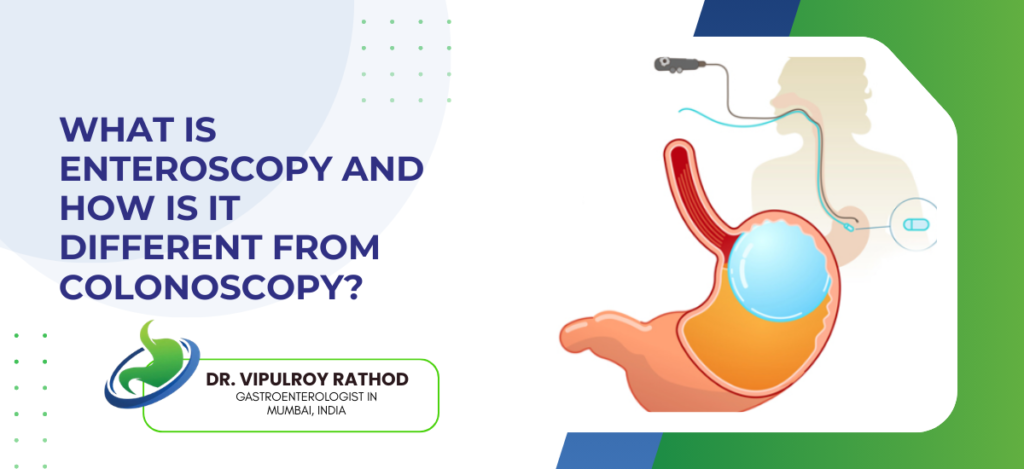
Enteroscopy looks at the small intestine. That’s the part of the gut neither a standard endoscopy nor a colonoscopy can actually reach. Different scope, different purpose, and the patients who need it are usually the ones who’ve already had everything else done and still don’t have answers.
According to Dr. VipulRoy,
“Double Balloon Endoscopy lets us reach and treat problems in the small bowel that would otherwise go undiagnosed for years. Most patients who need it have already had normal colonoscopy and endoscopy results. That’s exactly when enteroscopy becomes the next step.”
What Enteroscopy Actually Is?
- Most of the small bowel is invisible to standard scopes — Upper endoscopy gets through roughly the first 30 centimetres from the mouth. Colonoscopy comes in from the other end and covers the large intestine. The remaining 6 to 7 metres of small bowel sits between them, untouched by either.
- Enteroscopy gets in there using a balloon system — A double balloon or single balloon scope uses an overtube and alternating balloon inflation to fold the small intestine back onto itself. The scope edges forward bit by bit. It’s slow, deliberate work — nothing like a routine endoscopy.
- Treatment happens in the same sitting — Whatever the doctor finds, whether it’s a bleeding vessel, a polyp, or a stricture, it gets dealt with then and there. Biopsy, cauterisation, dilation — all possible without booking a second procedure.
- It takes time and preparation — Longer than any standard scope. More sedation. More setup. But for patients who’ve been bounced between normal results for months or years, it’s often the only investigation that actually finds something. As a gastroenterology specialist in Mumbai, Dr. Rathod does this at Fortis Hospital Mulund for exactly those cases.
How It Differs From Colonoscopy?
- Colonoscopy is for the large bowel — Colon, rectum, and the very last bit of small bowel called the terminal ileum. That’s its territory. Good for colorectal cancer screening, polyps, IBD. Most people over 50 have had one. It has nothing to do with the small intestine proper.
- Enteroscopy is for what colonoscopy can’t reach — The jejunum and ileum. The long middle stretch of digestive tract that, before enteroscopy existed, surgeons had to open the abdomen to examine. Nobody did it unless they absolutely had to.
- They get ordered for completely different reasons — Persistent unexplained GI bleeding after normal upper and lower scopes. Crohn’s suspected in the small bowel. A mass or narrowing picked up on imaging but not reachable by standard endoscopy. Malabsorption that celiac testing didn’t explain. None of these are colonoscopy cases.
- Ordering the wrong one wastes months — Patients sometimes wait for a colonoscopy when what they actually need is an enteroscopy. The results come back normal, nothing changes, and the actual problem keeps going undiagnosed. You can explore our previous blog What Is EUS-Guided Drainage and When Is It Recommended? to understand how specialised GI procedures fill diagnostic gaps that routine investigations leave behind.
Why Choose Dr. Vipulroy Rathod for Enteroscopy in Mumbai?
Most GI centres don’t have the equipment for double balloon enteroscopy. The ones that do don’t all have someone who’s been doing it long enough to handle difficult anatomy or unexpected findings mid-procedure. Dr. Vipulroy Rathod has been at Fortis Hospital Mulund for over 30 years doing exactly this kind of advanced diagnostic work. The patients who end up here are often the ones carrying a thick file of inconclusive reports. Sometimes enteroscopy is the first investigation that actually shows something. That happens more often than it should which is why getting the right specialist matters.
Still getting normal results but something is clearly wrong? A specialist evaluation of the small bowel may be what’s missing.
Frequently Asked Questions
Done under sedation so there’s no pain during the procedure. Some abdominal discomfort and bloating after is normal and resolves within a day.
Typically 60 to 90 minutes depending on how far into the small bowel the doctor needs to go. Recovery adds another couple of hours before discharge.
Yes. Bleeding sources can be cauterised, polyps removed, and strictures dilated during the same procedure. It’s not just diagnostic.
Anyone with unexplained GI bleeding, suspected small bowel Crohn’s, or small bowel tumours where upper and lower endoscopy came back normal. Colonoscopy simply doesn’t reach far enough for these cases.
Reference links-
- Enteroscopy and Small Bowel Endoscopy — American Society for Gastrointestinal Endoscopy
- Small Intestine Disorders and Diagnosis — American College of Gastroenterology
- Double Balloon Enteroscopy Clinical Data — National Library of Medicine
- Small Bowel Endoscopy Standards — World Gastroenterology Organisation